The WA Christmas Tree: A Golden Icon of Our Summer Landscape
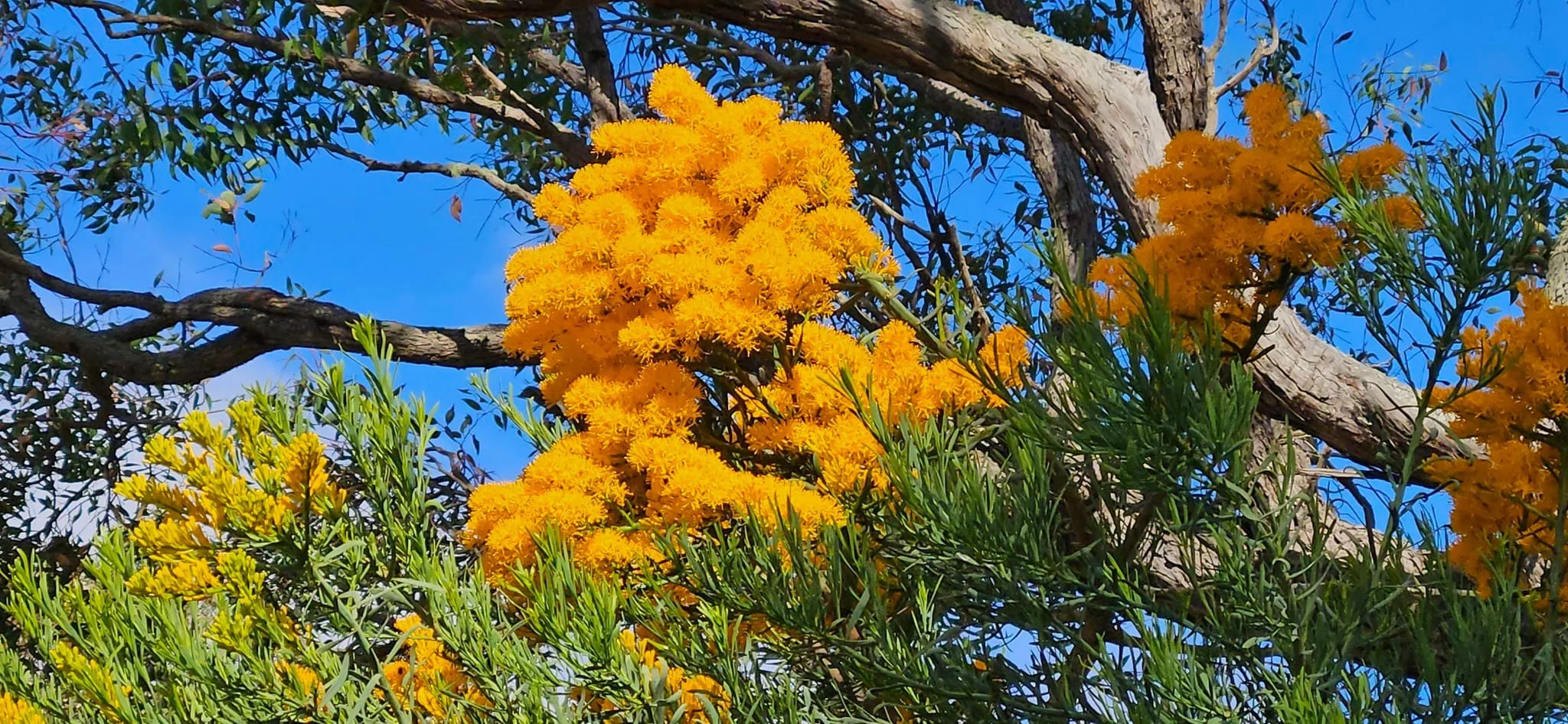
If you’ve driven through the Great Southern lately, you’ve probably noticed them — bursts of blazing gold scattered across paddocks, road verges, and bushland. Our beloved Western Australian Christmas Tree (Nuytsia floribunda) is in full bloom, and it’s impossible not to feel a little awe when these spectacular trees light up the landscape.
Here at Amaris Wildlife, we’re surrounded by them — glowing like lanterns across the property — and they’re a reminder of just how extraordinary our local flora truly is.
A Tree Like No Other
The WA Christmas Tree isn’t just beautiful — it’s one of the most fascinating plants in the world.
It’s a hemiparasitic tree, meaning that while it photosynthesises like other plants, it also taps into the roots of nearby vegetation to draw water and nutrients. Its underground network is extraordinary: roots and rhizomes can extend astonishing distances, forming tiny structures called haustoria that attach to the roots of surrounding plants.
Despite this unusual lifestyle, the tree doesn’t harm its neighbours. It takes only a little from each host, spreading its needs across many plants so that no single species is significantly affected.
A Blaze of Colour for Wildlife
When the WA Christmas Tree blooms, it becomes a magnet for life.
The bright, nectar‑rich flowers attract:
bees
butterflies
native insects
nectar‑feeding birds
These trees play an important ecological role, offering food at a time of year when many species are raising young and resources can be scarce.
A Sacred Place in Noongar Culture
For Noongar people, the WA Christmas Tree — Moodjar — holds deep cultural and spiritual significance. It is considered a spirit tree, connected to the passage between the physical world and the spiritual one. In many Noongar stories, the Moodjar is associated with the journey of spirits after death, and the area around these trees is treated with great respect.
Because of this sacred connection, it is traditionally understood that the flowers should not be picked. Taking parts of the tree is seen as disturbing a place where spirits may rest or travel. Even today, many Noongar Elders gently remind people to admire the Moodjar from a distance and leave the blossoms where they are.
This cultural teaching aligns beautifully with ecological care too — the flowers are an important food source for insects and birds during the hottest part of the year, and leaving them in place supports the health of the whole ecosystem.
A True Western Australian Original
Nuytsia floribunda is found only in Western Australia, from the Murchison River down to the Great Australian Bight. It grows in sandy or granitic soils, thriving in open woodland, heath, and paddock edges — which is why we see so many around Amaris Wildlife.
It can grow as a shrub or a tree up to 10 metres tall, with rough grey‑brown bark and those unmistakable golden flower clusters that can reach up to a metre long.
Why They’re So Hard to Grow Elsewhere
People often ask why WA Christmas Trees aren’t commonly planted in gardens.
The answer lies in their parasitic nature. They need a network of host plants to survive, and attempts to grow them outside their natural environment usually fail after a year or two. They’re deeply tied to the ecology of this region — another reason they feel so special.
A Seasonal Gift From Country
For us at Amaris Wildlife Sanctuary, the flowering of the WA Christmas Tree is a reminder of the resilience and beauty of our local ecosystems. These trees have been part of Noongar Country for thousands of years, woven into cultural stories and seasonal knowledge.
Seeing them in full bloom across the sanctuary is a gift — a golden celebration of summer, life, and the unique biodiversity we’re working to protect.
If you’re visiting the region over the next few weeks, take a moment to appreciate these extraordinary trees glowing across the landscape. They’re one of Western Australia’s true natural treasures.