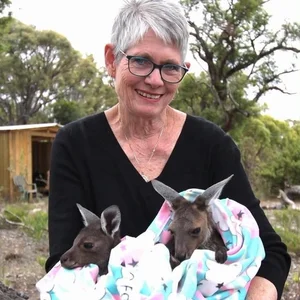
Is This What Our Kangaroos Are Worth Now?
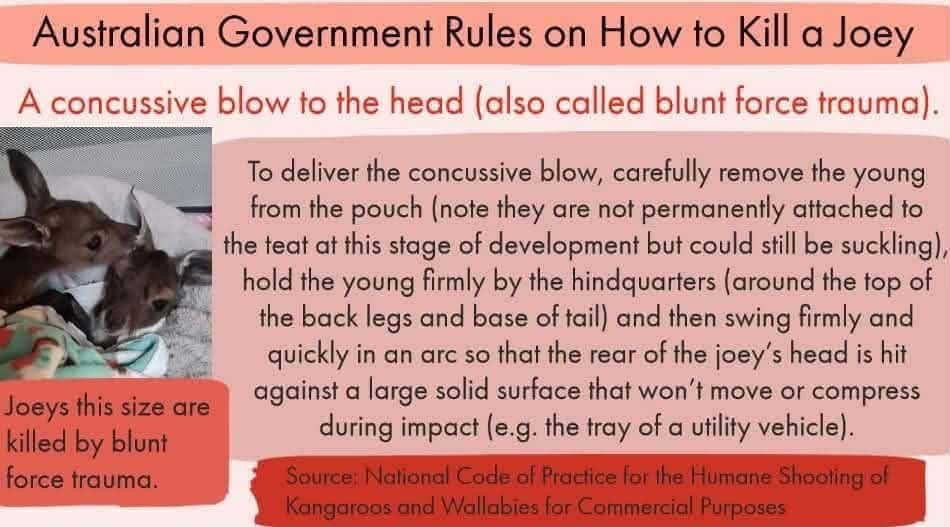
Before you read this, please look at the image above.
I want you to look closely at it.
I was once part of the People Against Killing Kangaroos group, and images like this were created to show people what really happens in the world of so-called kangaroo harvesting.
And I think we need to be honest about the language we use.
You harvest wheat.
You harvest barley.
You harvest canola.
You harvest a crop.
You don't harvest a life.
Yet somehow, we have become comfortable calling the killing/murder of wild kangaroos a "harvest", as though changing the word somehow makes it less confronting.
It doesn't.
The image above is confronting because the reality is confronting.
And there is something else that makes this particular image incredibly personal to me.
One of the joeys pictured is our Jaffa Roo.
Jaffa is not a statistic to us.
Jaffa is not a number in a population estimate.
Jaffa is not a kilogram of meat.
Jaffa is a living being whose life mattered.
And that is what makes this issue so difficult for those of us who rescue and care for Australia's wildlife.
We don't see kangaroos as a resource.
We see them as individuals.
We see their faces.
We learn their personalities.
We watch them grow.
We hold them when they are frightened.
We bottle-feed them through the night.
We sit beside them when they are injured.
We celebrate their first hop.
And, when we are lucky, we watch them walk away into the bush to begin their lives again.
That is the world of wildlife care.
And then we look at the other side of the equation and see Australia's wild kangaroos being described as a commercial "harvest", with meat being prepared for export markets around the world.
The Australian Government itself describes kangaroos as free-ranging wild animals and regulates the commercial kangaroo meat export industry. It also states that four kangaroo species and two wallaby species are permitted for commercial harvesting for meat export.
And the Australian Government has a National Code of Practice for the humane shooting of kangaroos and wallabies for commercial purposes.
Read that sentence again.
There is a national code that sets out how the killing is supposed to be carried out.
And the image above reminds us that when a mother is killed, there can be a dependent joey left behind.
That is the part that the word "harvest" conveniently hides.
Now our kangaroos are becoming part of an international trade opportunity
The Australian Government is proudly talking about deepening Australia's Comprehensive Strategic Partnership with Vietnam, strengthening economic ties and creating new opportunities for businesses in both countries.
Those are important diplomatic and economic objectives.
But buried within this new relationship is something that should concern every Australian who cares about our wildlife.
Vietnam has agreed to recommence market access for Australian game meat, including kangaroo meat, with the Australian Government working towards trade commencing as soon as possible in 2026.
And that leaves me asking one very simple question:
Is this what our kangaroos are worth now?
Is this what one of Australia's most recognisable native animals has become?
Another export opportunity?
Another product on an international dinner menu?
Another way to strengthen economic ties?
Because when we talk about "economic opportunities", we are talking about living animals being killed and turned into a commodity.
And I have to ask:
At what point do we decide that some things are worth more than money?
What is a kangaroo worth?
What is the value of a mother kangaroo carrying a tiny joey in her pouch?
What is the value of a young kangaroo learning to stand?
What is the value of the frightened little face looking out from a pouch after its mother has died?
What is the value of the hours a wildlife carer spends keeping that joey alive?
What is the value of a life that could have had another five, ten or fifteen years in the Australian bush?
Can we put a dollar figure on that?
Because I can't.
And I don't want to.
At Amaris Wildlife Sanctuary, we know what a kangaroo is worth.
Its life.
That's it.
Not its meat.
Not its skin.
Not its export value.
Its life.
These are wild Australian animals
Kangaroos are not cattle.
They are not sheep.
They are not a crop.
They are not animals that have been bred for generations to become part of an agricultural food system.
They are wild Australian animals.
They belong to this country.
They belong in our bushland, our forests, our open country and our landscapes.
They are part of what makes Australia uniquely Australia.
And yet we continue to discuss them in terms of population numbers, quotas, markets, exports and economic opportunities.
Of course numbers and conservation matter.
Of course governments need to manage wildlife.
But perhaps we have become so accustomed to talking about kangaroos as a "resource" that we have forgotten something fundamental.
Every number represents an individual animal.
Every mother.
Every joey.
Every young kangaroo that will never grow old.
We are asking Australia to look again
We are not against Australia having a strong relationship with Vietnam.
We are not against cooperation between nations.
We are not against Australian businesses succeeding.
But we do believe that there should be some things that Australia chooses not to turn into a commercial opportunity.
And surely our unique native wildlife deserves to be one of them.
The Australian Government says it wants to strengthen economic ties and create new opportunities for businesses.
But what about creating new opportunities for wildlife?
What about investing in wildlife hospitals?
What about supporting wildlife carers?
What about habitat restoration?
What about wildlife rescue and rehabilitation?
What about protecting the animals that make Australia special in the first place?
Because there is another Australia that exists beyond trade agreements and export figures.
It is the Australia we see every day.
The Australia of the kangaroo standing at the edge of the bush at sunrise.
The mother with her joey tucked safely in her pouch.
The little orphaned joey arriving at a wildlife carer's door.
The exhausted carer preparing another bottle at 2 am.
The moment a rehabilitated kangaroo takes those first steps back into freedom.
That Australia matters too.
And Jaffa matters
Perhaps that is why I wanted to share this image.
Because sometimes statistics don't make people stop and think.
But a face does.
And one of those faces belongs to Jaffa Roo.
Jaffa reminds us that behind every number is a living individual.
A personality.
A life.
A story.
Jaffa could easily have been just another statistic.
Instead, Jaffa became a life that someone fought for.
Someone cared.
Someone bottle-fed.
Someone loved.
That someone was me!
And that is what wildlife carers do every day.
We fight for the individual.
So when we hear the word "harvest", we don't hear a harmless agricultural term.
We hear what it can conceal.
A life taken.
Our kangaroos are worth more than this.
Australia has an extraordinary opportunity to show the world that being a wealthy, successful nation does not mean putting a price on everything that lives within our borders.
We can strengthen international relationships.
We can trade.
We can cooperate.
We can build businesses.
And we can still choose to protect our wildlife.
Because a kangaroo is not an Australian product.
A kangaroo is an Australian life.
And at Amaris Wildlife Sanctuary, we will continue to rescue them, care for them, rehabilitate them and speak for them.
Because they cannot speak for themselves.
And if we don't speak up for them—
who will?
They deserve more than a price tag.
They deserve to live.
Sources: Australian Government Department of Agriculture, Fisheries and Forestry — information on Australia's commercial kangaroo meat export industry and the National Code of Practice; Australian Government Department of the Prime Minister and Cabinet — Australia–Vietnam economic partnership announcements.