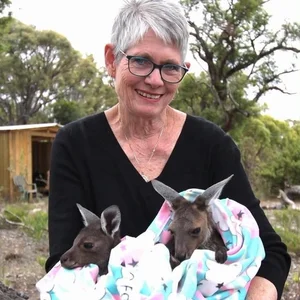
"I'm Sorry for the Inconvenience"
The Silent Apology of Australia's Wildlife
"I'm sorry."
Those words are ones we hear every day.
But imagine if our wildlife could speak.
Imagine the voices we would hear.
"I'm sorry I am badly hurt and I'm lying here in a farmer's paddock. I can't move.
I know you are 50 minutes away and that's a long drive. I'll try to be patient.
My baby is still in my pouch. I'm trying to protect her, even though I haven't had food or water today.
The eagles are circling overhead.
I hurt so much.
But I'll wait."
"I'm sorry that roaming dogs attacked me outside office hours.
I'm badly injured, but that's okay. I'll wait until morning when someone is available.
I know it's inconvenient."
"I'm sorry I'm caught in a fence. It wasn’t there yesterday
I know it happened after business hours. I'll try to be more thoughtful next time and get trapped when the office is open.
I'll just hang here until it's convenient for someone to answer the phone.
I know I'll probably be dead by morning.
I'm sorry for the inconvenience."
"I'm sorry my mummy was killed by a car.
A kind lady found me beside her body.
I'm a long way from town.
I'm sorry to be a nuisance, but could somebody please come and get me?
If no one comes, I will die too.
I just want a new mummy. I want to live."
Of course, kangaroos don't speak.
They don't complain.
They don't send emails, fill out forms, or understand office hours.
They are simply suffering.
In silence.
And suffering doesn't follow a timetable.
It doesn't wait until Monday morning.
It doesn't check whether there is funding available, whether staff are rostered on, or whether the rescue is too far away.
It just happens.
At midnight.
At dawn.
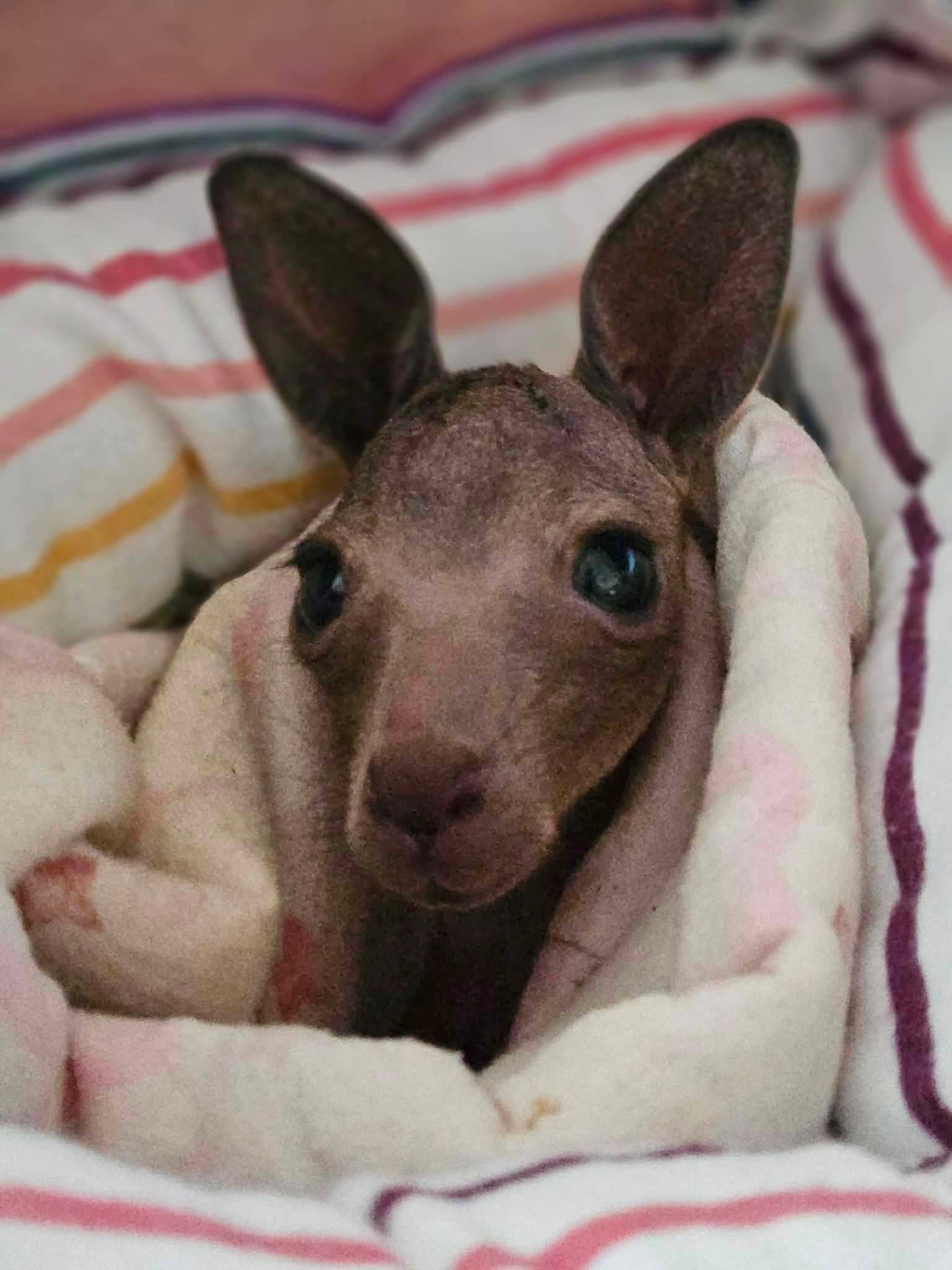
A volunteer drove over 3 hours to collect this baby and bring her into care.
On Christmas Day.
During storms.
In the middle of nowhere.
And when it does, there is an extraordinary network of people who answer the call.
Phones begin ringing.
Messages start dinging through volunteer chat groups.
Someone knows a carer.
Someone knows a transporter.
Someone is already halfway there.
Someone puts down their dinner.
Someone leaves their family gathering.
Someone gets out of bed at midnight.
Someone drives an hour.
Then another.
Then another.
Not because they are paid.
Not because it is convenient.
But because an animal is suffering and needs help.
A volunteer races out to collect the orphaned joey.
A wildlife carer prepares a warm pouch and formula.
Another volunteer heads out to locate an injured mother and her joey.
Someone sits beside an animal whose pain can no longer be relieved and gives them the kindness of a peaceful ending.
Someone else becomes the new mum for a tiny orphan who has lost everything.
This is the reality of wildlife rescue.
This is what happens every single day behind the scenes.
The public often sees the happy ending.
The joey in a pouch.
The release photo.
The success story.
What they don't always see are the kilometres travelled, the sleepless nights, the heartbreaking decisions, the tears, the fuel bills, the phone calls and the relentless determination of volunteers who refuse to let an animal suffer alone.
At Amaris, we know that wildlife emergencies do not happen on our schedule.
Animals don't get to choose where they are injured, how badly they suffer, or whether help is nearby.
That's why our volunteers stand ready to do what they can, whenever they can.
Because every kangaroo, every joey, every wombat, every possum and every native animal deserves compassion.
They deserve to be seen.
They deserve to matter.
And they deserve more than an apology for being inconvenient.
So if you see an injured animal, don't assume someone else has already called.
Don't assume help is coming.
Let somebody know.
Reach out.
Make the call.
Because while wildlife may never ask for help in words, their suffering speaks loudly enough.
And when help is needed, our volunteers will do everything they can.
Because no animal should suffer alone.
You let us know, and someone will go.
So, Who Is Responsible?
It is a question we hear over and over again.
A kangaroo is lying injured in a paddock.
A joey is sitting beside its dead mother.
A kangaroo is tangled in fencing.
A native animal has been attacked by dogs.
A motorist stops, horrified, wanting to help.
And then comes the question:
"Who do I call?"
Too often, the answer is unclear.
One agency says it is not within their jurisdiction.
Another says it is only their responsibility if the animal is on a reserve.
Police may only attend if there is a public safety risk or traffic hazard.
Councils have limited resources and differing responsibilities.
Meanwhile, the animal is still lying there.
Still suffering.
Still waiting.
The reality is that wildlife does not understand jurisdictions, boundaries, office hours, budgets, policies or operational priorities.
It only knows pain.
And while organisations debate responsibility, volunteers are already on the road.
Not because they have to.
Because they choose to.
Because someone has to.
Because when a frightened member of the public asks, "Can somebody help?", it is often wildlife volunteers who answer.
The uncomfortable truth is that much of Australia's wildlife rescue system is held together by ordinary people doing extraordinary things.
People using their own vehicles.
Their own fuel.
Their own equipment.
Their own time.
People who leave work early, miss family dinners, get out of bed at midnight and drive hundreds of kilometres because a living creature is suffering and cannot wait until tomorrow.
We are not writing this to point fingers.
We are writing this because the system leaves many people confused and many animals waiting.
Wildlife belongs to all of us.
Yet when they are injured, abandoned, trapped or dying, responsibility often becomes blurred.
So where do we go from here?
Perhaps the better question is:
What kind of society do we want to be?
One where suffering waits for office hours?
Or one where compassion steps forward when help is needed?
Until there is a clearer answer, wildlife volunteers across Australia will continue doing what they have always done.
Answering the phone.
Responding to the message.
Making the drive.
Taking the call.
Picking up the orphan.
Helping the injured.
Easing the suffering.
Because for the kangaroo lying alone in a paddock, the joey beside its dead mother, or the animal trapped in a fence, responsibility is not a policy discussion.
It is a matter of life and death.
And while others ask whose job it is,
we will keep asking where the animal is.