The Dark Reality of the US Exotic Trade: How "Pouch Pulling" Turns Wild Macropods into Backyard Novelties
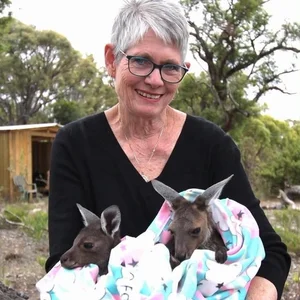
At Amaris Wildlife Sanctuary our days are defined by a single, unwavering goal: rehabilitation for release. Every orphaned joey—like our beloved Lucy, Belle, and Katie —that comes into our care is treated with immense respect for its wild nature.
We wake up for freezing 2:00 AM feeds, meticulously calculate marsupial-specific formulas, and carefully limit human interaction by introducing another one or two into the mix. . We do this because we know that a macropod’s survival depends on it remaining wild, independent, and connected to the bush.
As wildlife carers, we routinely see the devastating impact of trauma. We nurse joeys who are shaking with shock after losing their mothers to car strikes or dog attacks. We spend weeks stabilising their fragile systems, soothing their terror, and trying to heal the deep psychological wounds of their loss.
Because we see what genuine trauma does to these sensitive animals, what happens across the ocean in the United States is completely unfathomable to us.
In the US, kangaroos and wallabies are not protected wildlife; they are legal commodities. In states like Kentucky, Alabama, and Texas, backyard breeding is a booming, multi-million-dollar industry where wild animals are systematically stripped of their identity to be sold as house pets and roadside entertainment.
Here is the documented evidence of how the US exotic animal trade operates—and the devastating welfare fallout it causes.
1. "Pouch Pulling": Unfathomable Trauma for Profit
To an Aussie rescuer, hand-raising an orphan is a grueling act of necessity to save a life. To an American exotic breeder, it is a deliberate commercial strategy known as "pouch pulling" or "forced weaning."
Breeders routinely and deliberately rip healthy, thriving joeys away from their mothers at an incredibly fragile stage. They do this because a joey left to grow naturally with its mob becomes "unhandleable" and entirely useless for the pet market.
To anyone who understands macropods, the sheer cruelty of this practice is heartbreaking:
The Mother's Anguish: A wild kangaroo mother shares a profound physiological and emotional bond with her joey. When a breeder violently reaches into her pouch and tears her baby away, the distress is catastrophic. She will frantically search, vocalise, and pace her enclosure in deep mourning. Shockingly, commercial operators callously dismiss this grief, with some even claiming the mothers are "relieved" to have their joeys removed—a sickening justification used to immediately re-breed the female for the next profitable joey.
The Joey's Terror: Suddenly deprived of its mother’s unique scent, the rhythmic thump of her heartbeat, and the safety of her pouch, the joey is plunged into absolute survival terror. Breeders exploit this state of pure shock. They force the traumatised joey to depend on humans for survival, hijacking its natural instincts to force it to imprint.
This profound, manufactured trauma-bonding is then packaged and marketed to the public as "love."
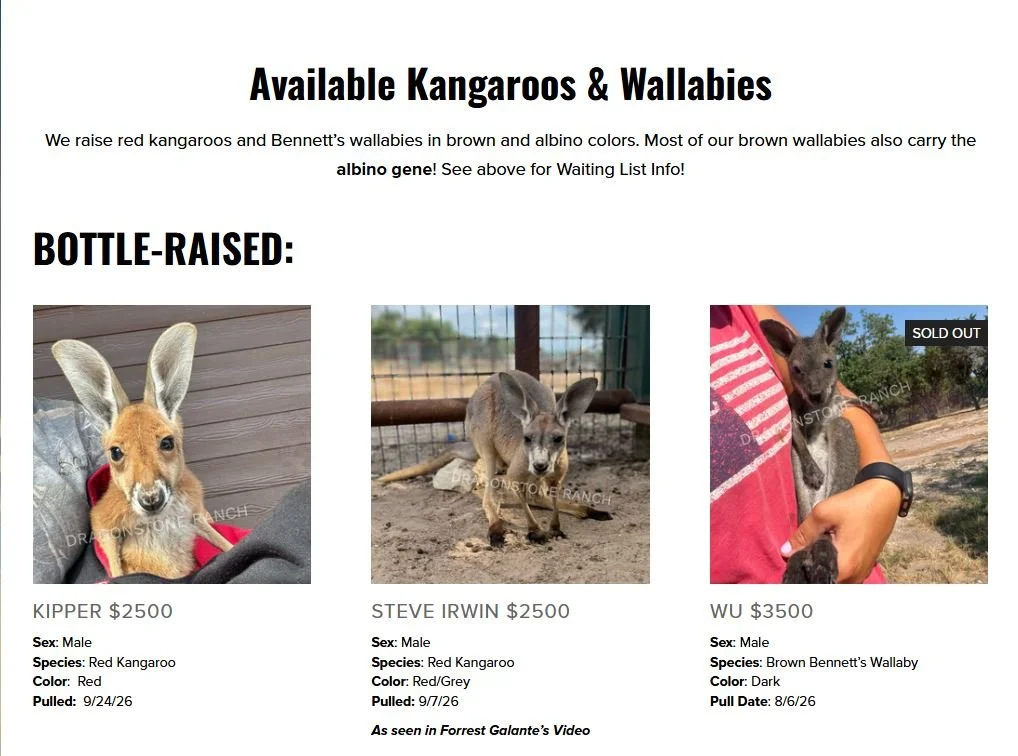
The "Tame" Sales Pitch: Major US commercial breeders, such as Dragonstone Ranch in Texas, explicitly advertise that 100% of their red kangaroo and Bennett’s wallaby joeys are "hand-raised, tame, and on the bottle." They ship these fragile animals across the country with a starter pack of bottles, teats, and formula.
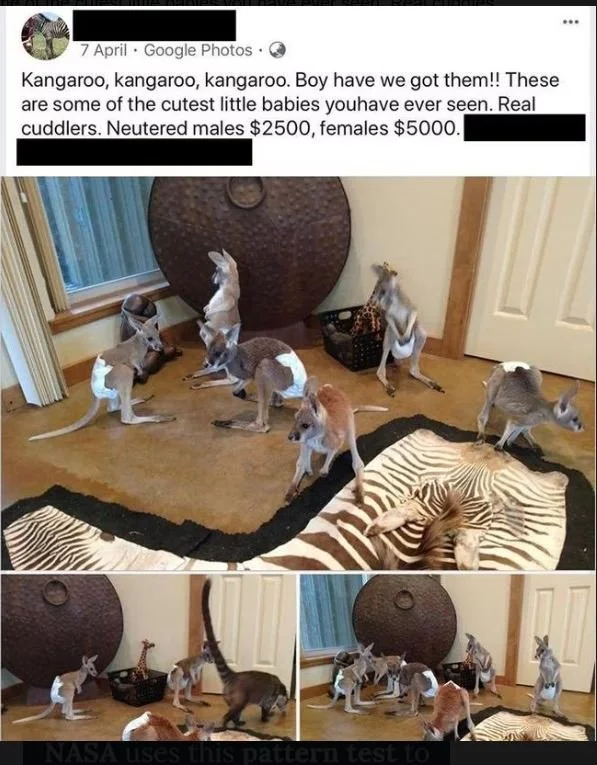
The Price Tag on Cruelty: An un-imprinted, parent-raised kangaroo has little value in the US pet trade. However, a pouch-pulled, bottle-dependent joey fetches astronomical prices—typically ranging from $2,500 to over $5,000 USD (upwards of $7,500 AUD), with rare colour mutations like albinos commanding even more.
2. The Illusion of the "Weaving" House Pet
Googling "pet kangaroo" in the US reveals thousands of images of joeys wearing human clothes, nappies, and sitting on living room couches. This exploitation directly feeds private buyers and the American "roadside zoo" circuit.
Facilities like Mandalay Farms in Florida openly host events like "Kangaroo Playdates," where captive-raised red kangaroos are marketed for public entertainment. Heavily imprinted joeys are passed around by crowds of tourists, used as photo props, or hired out for children’s birthday parties. Mobile outfits like Fortner Farm in Alabama even rent out their exotic animal stock to daycare centres, festivals, and television sets.
The industry completely dismisses the physiological and psychological needs of the developing macropod, treating a wild, highly specialised species as a living toy.
3. The Legal Loopholes Fueling the Trade
How is this legal? In states like Kentucky, the regulatory system is practically non-existent for exotic marsupials.
The Kentucky Department of Fish and Wildlife does not classify kangaroos as "inherently dangerous" animals. This means that if a kangaroo or wallaby is purchased within state borders, birds-eye oversight is gone: no permit, license, or registration is required.
This complete lack of state-level oversight has created a thriving, unregulated grey market. On local agricultural trading pages, such as the Facebook group for Kentucky Farm Animals, kangaroos are openly bartered alongside standard livestock like sheep and goats. Because Facebook officially bans the sale of live animals, these transactions are driven into private messages to evade moderation, leaving buyers highly vulnerable to rampant online scams.
4. The Inevitable Tragedy: No Escape, No Sanctuary, No Freedom
The "cute joey" fantasy inevitably ends, and the final stage of this trade is perhaps the most tragic.
Surging Hormones and Aggression: As any experienced carer knows, a joey does not stay small forever. When these hand-raised kangaroos reach sexual maturity, their wild instincts and surging hormones kick in. Male red kangaroos begin to display dominant boxing and kicking behaviours. Because they were forced to imprint on humans, they have zero natural fear of people, making them incredibly dangerous.
The Myth of the "Rescue" Sanctuary: When an owner realises they can no longer handle an aggressive, 60kg adult male kangaroo, they find out the hard way that there is no large-scale network of free-roaming kangaroo sanctuaries in the United States. Unlike big cats or primates, macropods have almost nowhere to go. Venues that call themselves "rescues" are often just roadside attractions that put the animal right back into high-contact tourist enclosures to pay for their keep.
The Final Fallout: Because kangaroos are an introduced exotic species in North America, they can never legally or ecologically be released into the wild. A rescued joey in the US faces a life sentence in captivity. If they aren't dumped at low-tier petting zoos, they are quietly sold at unmonitored livestock auctions, or privately euthanised behind closed barn doors because the owner is too terrified to enter their pen. Standard farm fencing is entirely useless for macropods, leading to frequent escapes where animals are hit by cars or face severe malnutrition because US vets have no training in marsupial care.
A Stark Contrast in Values
For wildlife carers in Australia, watching this industry from afar is utterly heartbreaking. It stands against everything wildlife rehabilitation represents.
Where we see a wild, highly specialized species that belongs to the Australian bush, the US exotic trade sees a prop, a pet, and a paycheck. Once a joey is violently pulled from its mother's pouch in the US, its chance of ever experiencing true freedom is permanently gone.
This devastating reality reinforces exactly why our work at Amaris Wildlife Sanctuary is so vital. We must continue to protect these magnificent animals, preserve their wildness, and ensure they are treated with the dignity they deserve—never reduced to commodities in a cage.
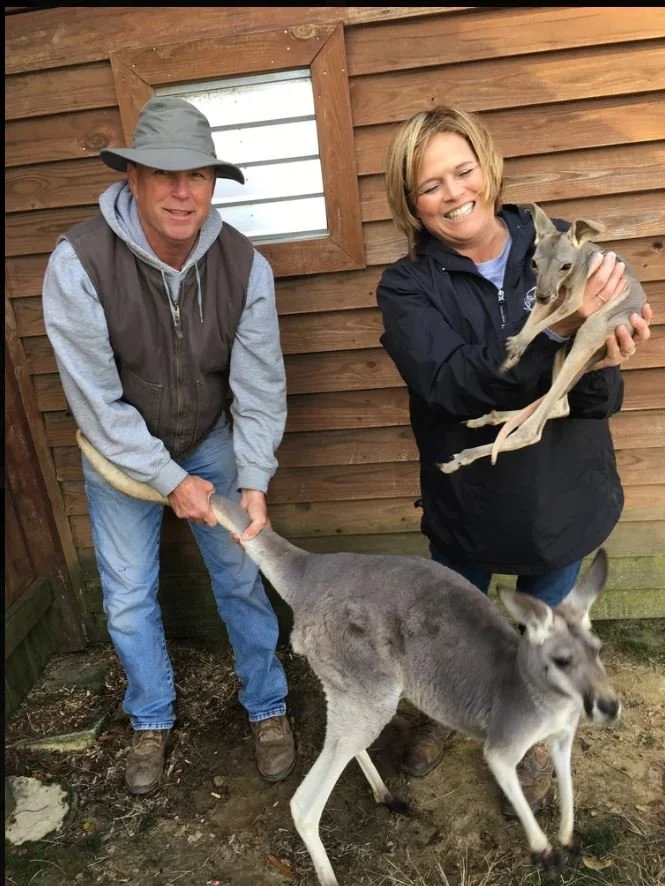
This 2.7 kg joey was pulled from its mother…They called this another good day!!