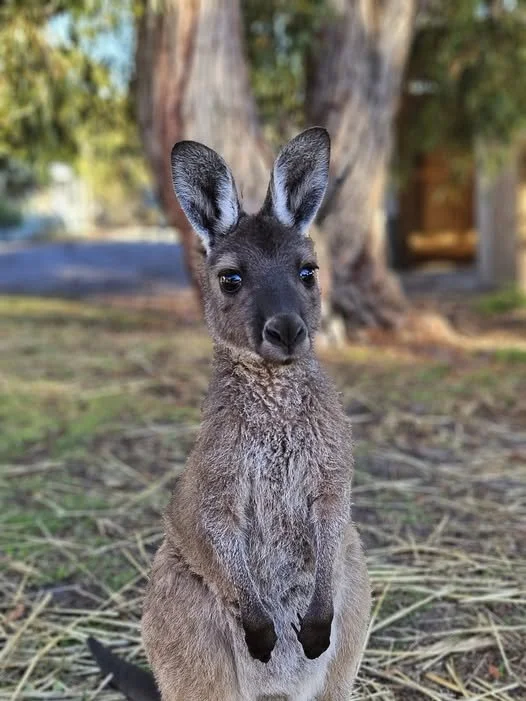
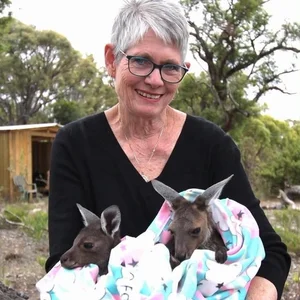
Stop “Raising” Joeys. Start Doing the Right Thing.
Somewhere in Australia tonight, a wildlife carer is awake in the dark — exhausted, heartbroken, and trying to settle a terrified joey that has just been “handed in.”
The joey hisses when anyone comes close. It bites. It scratches. It screams. And the carer — who would love nothing more than to hold it tight and whisper, you’re safe now — can’t. Because to that joey, a human is a predator. A threat. A stranger.
And here’s the part people don’t want to hear:
This isn’t the normal grief of a wild joey that has just lost its mum.
Yes, wild joeys suffer. Yes, they mourn. But this level of panic — the confusion, the aggression, the complete inability to cope — is often what we see when a joey has been kept by people.
A joey that has been “raised” in someone’s lounge room. A joey that has never met another kangaroo. Never learned how kangaroos are. Never had a chance to learn boundaries, language, safety, movement, hierarchy — the things that make survival possible.
It doesn’t know it’s a kangaroo.
It thinks it’s… something else. A person. A dog. A toy. A baby.
And then one day, suddenly, it becomes inconvenient.
It’s usually a holiday that triggers it:
“We’re going away.”
Or the joey stops being cute and starts being wild:
“It’s getting difficult.”
Or the kids are now frightened of the animal they were encouraged to cuddle:
“It’s scratching. It’s biting.”
So someone rings a carer:
“Can you take my joey?”
Let me give you an analogy that makes it painfully clear:
Imagine taking a human baby, raising them inside a house, and never allowing them to see other children.
No daycare.
No park.
No school.
No social learning.
No community.
Just the family… and maybe a bear cub for company.
Then, one day, at “high school age,” you drop them at the gate and say:
“Bye. You’ve got it from here.”
Ridiculous? Of course it is.
But that is essentially what you are doing when you raise a joey privately and then “hand it in” later.
You are creating an animal that is socially and behaviourally unprepared for its own species, and then expecting a volunteer carer to undo what took months to embed — often with trauma, stress, and suffering involved.
And here’s the blunt truth: carers pay the price
Carers pay with sleep.
With money.
With their homes, their time, their marriages, their mental health.
Carers pay vet bills, fuel, milk formula, medications, heating, pouches, bedding, cages, and emergency equipment.
The ABC has reported research showing wildlife carers average 32 hours a week caring for wildlife and spend around $5,300 a year out of pocket on food and supplies. That’s volunteer labour keeping wildlife alive while the public plays “temporary parent.” (https://www.abc.net.au/news/2023-06-08/wildlife-carers-welfare-concerns-vet-calls-system-change/102440856)
I’ve lived this
We have taken in joeys like this.
We have treated the severe stress outcomes.
We have worked for months — sometimes years — to repair the damage enough that a release can even be considered.
Yes, in one case, we saved a joey from severe myopathy and, after an enormous amount of time and careful management, he was able to be safely released. But at what cost? To him? To the carers involved? To the wildlife system that is already stretched beyond breaking?
We don’t get paid for this.
We do it anyway — because it’s about them, not us. Because animals suffer if we don’t step in.
But it needs to be said clearly:
This needs to stop.
So here’s the rule — and I’m not sugar-coating it:
If you find a joey, or someone hands you a joey…
Do the right thing and hand it over to a licensed wildlife carer or wildlife hospital immediately.
Not tomorrow.
Not next week.
Not after you’ve “bonded.”
NOW.
Because every day you keep that joey:
you increase the risk it becomes imprinted
you reduce its chance of normal development
you increase stress when it eventually enters proper care
you shift the burden onto volunteers who already carry too much
If you genuinely care about that joey — prove it by letting it have what it actually needs: its own species, proper care, and a real chance at a wild life.
If you’re reading this and feeling defensive…
Good. Sit with it.
Because wildlife doesn’t exist to fill a hole in your heart, entertain your children, or become a story you tell at BBQs.
Wildlife belongs in the wild.
And if you can’t support that, then you’re not rescuing — you’re taking.
Do better.
Do the right thing.
Right now.